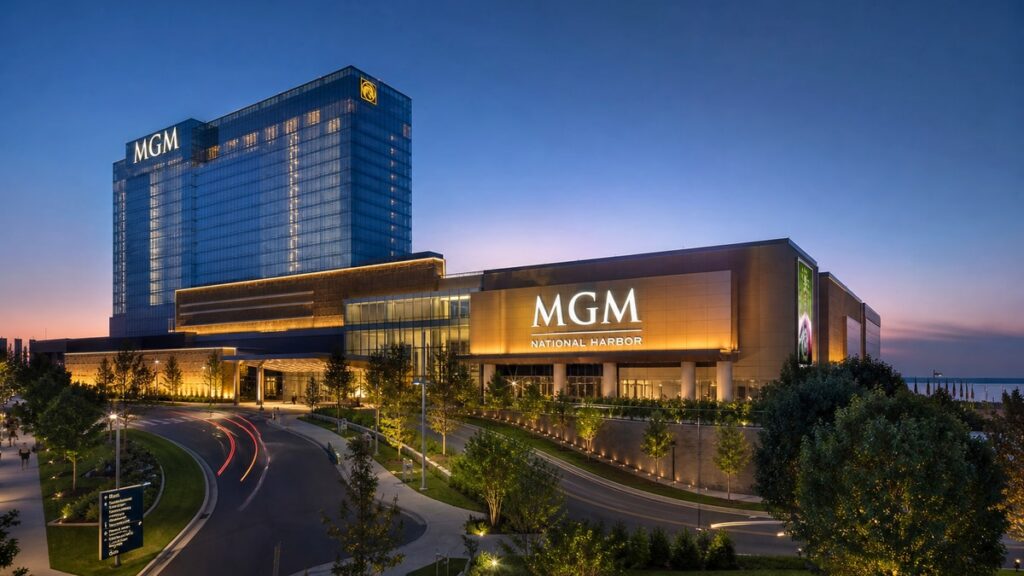
Maryland’s six commercial casinos opened Fiscal Year 2027 on a down note, combining for $157.9 million in gaming revenue during July, a 4.7% drop from the same month a year earlier. The figures, released by the Maryland Lottery and Gaming Control Agency, mark the first monthly report of the new fiscal year, which runs from July 2026 through June 2027.
Statewide, slot machines and table games generated $157,864,080 in July, down $7,797,814 from July 2025. That slide also hit state coffers directly, with total casino gaming contributions falling to $68,183,830, a 3.5% year-over-year decrease. Of that total, $49,887,124 flowed into Maryland’s Education Trust Fund, while the remainder was split among host communities and jurisdictions, the state’s horse racing industry, and small, minority- and women-owned business support programs.
MGM National Harbor Leads the Slide
The decline wasn’t evenly distributed across Maryland’s gaming landscape. MGM National Harbor in Prince George’s County, the state’s largest casino by revenue, posted the steepest drop of any property, bringing in $60,205,298 in July, down $8,382,041, or 12.2%, from a year earlier. That single-month decline stands out in part because MGM had frequently been the lone Maryland casino posting year-over-year gains earlier in 2026, making the reversal notable heading into the new fiscal year.
Live! Casino & Hotel in Anne Arundel County, the state’s second-largest venue, held up considerably better, generating $59,227,515, a more modest 0.8% dip that kept the top two properties within roughly $1 million of one another for the month. With MGM’s drop, the gap between Maryland’s two biggest casinos narrowed sharply compared to earlier stretches of 2026.
Smaller Casinos Buck the Trend
While the state’s two largest properties struggled, four smaller casinos actually posted gains in July. Horseshoe Casino Baltimore generated $15,063,913, up 4.5% year-over-year, while Ocean Downs Casino in Worcester County brought in $10,476,145, an increase of 2.3%. Hollywood Casino Perryville in Cecil County reported $7,833,393, up 2.8%, and Rocky Gap Casino Resort in Allegany County recorded $5,057,816, a slight 0.8% decrease that was still far less severe than the drops posted by the market’s biggest players.
The mixed results suggest the softness in July wasn’t a broad, statewide pullback in gambling activity so much as a concentrated slump at the two largest venues, both of which face growing out-of-state competition. That dynamic is likely to draw continued attention as neighboring markets, including an expanding casino footprint in New York City, compete more directly for the same regional customer base that has long supported Maryland’s properties.
Coming Off a Record-Setting Fiscal Year
The July slide follows a Fiscal Year 2026 that, despite a similar year-over-year dip, still ranked as the fifth-best performance in the 16-year history of Maryland’s casino program. The state’s six casinos generated $1.931 billion in gaming revenue for FY2026, down 1.7% from the prior year, and contributed $822.2 million to state programs, with $599.1 million of that going to the Education Trust Fund alone. That pushed the fund’s total casino-driven contributions above $7 billion since Maryland’s first casino opened in 2010.
Maryland’s broader gaming and lottery ecosystem, including sports wagering, actually set a record in FY2026. Combined contributions from the Lottery, casinos, sportsbooks and fantasy sports operators reached $1.637 billion for the year, the highest total in the program’s history and $48 million more than the previous fiscal year’s record-setting mark. Sports wagering and fantasy competitions alone contributed a combined $133.3 million, up sharply from roughly $89 million in sports wagering revenue the year before, showing that Maryland bettors are increasingly diversifying where they spend their gaming dollars even as brick-and-mortar casino visits have softened.
Whether July’s dip proves to be a one-month blip or the start of a longer trend will become clearer as more of Fiscal Year 2027 unfolds. For now, the early read is that Maryland’s casino market remains healthy in the aggregate, buoyed by steady performance from its mid-sized properties, even as its two flagship venues navigate a noticeably tougher competitive environment than they saw for much of last year. Anyone tracking regional gaming trends can find the latest state-by-state breakdowns and Maryland sportsbooks coverage as the state’s numbers continue to develop through the rest of the fiscal year.
The smartest 5 minutes in betting
Get the week's best offers, line moves, and data-driven picks — straight to your inbox. No spam, unsubscribe anytime.
Join 240,000+ subscribers. 21+ only.