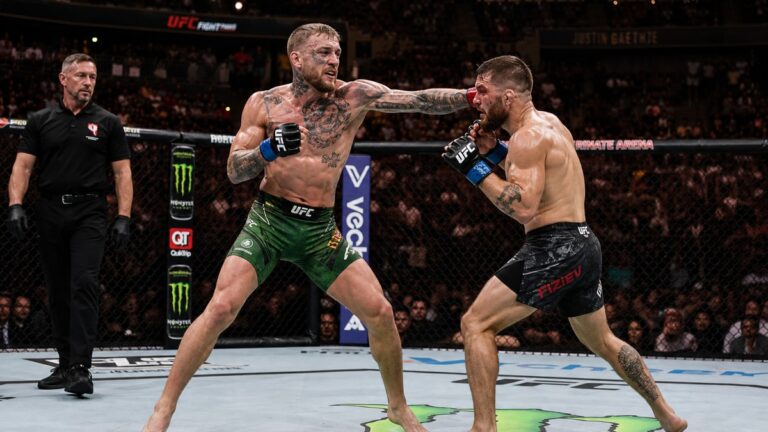
Conor McGregor is stepping back into the octagon for the first time in more than five years, and instead of easing back in at a familiar weight, he’s jumping straight into a welterweight main event against Max Holloway at UFC 329 on Saturday night at T-Mobile Arena in Las Vegas. Neither man has spent meaningful time at 170 pounds, and that alone makes this rematch one of the strangest style puzzles the promotion has put together in years.
Why the Weight Class Matters More Than the Storyline
McGregor built his entire UFC legacy at featherweight and lightweight, capturing belts at 145 and 155 pounds and never once competing above lightweight inside the Octagon. Holloway is arguably the greatest featherweight of all time, a former champion who owns nearly every meaningful record at 145 pounds, but he has also proven he can hang with bigger men — he moved up to lightweight for a run at Dustin Poirier and later fought as high as 155 against Justin Gaethje at UFC 300, where he scored a highlight-reel knockout. Neither man, however, has ever fought at welterweight before this booking.
That distinction matters because adding 15 pounds of allowable fight weight doesn’t just mean more mass on the frame — it changes cardio pacing, the way punches land, and how quickly fatigue sets in during championship-rounds action. Fighters moving up in weight for the first time typically report feeling stronger early but discover that carrying extra size changes their gas tank in ways that don’t show up until the third round.
McGregor’s Long Layoff Complicates the Physical Picture
McGregor hasn’t competed in the Octagon in over five years, and that layoff is arguably a bigger variable than the weight jump itself. Ring rust affects reaction time, footwork rhythm, and the ability to read distance — all things that are magnified against an opponent who has stayed active and sharp. McGregor’s calling card has always been leverage and timing on his left hand rather than pure size, so an extra 15 pounds could theoretically add pop to his power shots. But there’s no track record to lean on here; he’s never tested that power at this weight, against durable, live competition, in a real fight.
Holloway, by contrast, arrives with recent, relevant data. He was in the cage as recently as March 2026, has fought at the highest level continuously, and has already shown he can compete physically with bigger lightweights without his output or cardio collapsing. His gas tank has long been one of his signature traits — a fighter capable of throwing volume deep into the championship rounds — and that trait tends to translate reasonably well to a modest weight increase, since his style relies on pace and volume rather than raw knockout power.
What the Betting Markets Are Saying
The oddsmakers clearly see this as Holloway’s fight to lose. When the rematch was first announced, Holloway opened as roughly a -550 favorite with McGregor priced as high as +420, reflecting deep skepticism about a fighter returning from a five-plus year absence and stepping into unfamiliar territory at a new weight. That gap has tightened some as fight week has progressed, with Holloway settling in around the -200 to -230 range across most sportsbook reviews and McGregor sitting between +175 and +190, but the market still firmly favors the man with the more proven physical toolkit for this specific matchup. If you’re shopping lines before the walkouts, checking a few different DraftKings promo code offers or a FanDuel promo code can squeeze out better value on either side of this number.
That line movement is worth noting on its own. Books rarely see a gap that wide close entirely, and the fact that money has trickled toward McGregor suggests some bettors are banking on name recognition, home-crowd energy, and puncher’s-chance power rather than a fundamental disagreement with the physical read. The juice still sits clearly on Holloway’s side of the ledger. For bettors newer to combat sports, our how betting odds work guide breaks down exactly what that price gap means in real terms.
Cardio and Durability Tilt the Physical Debate
Fights at a new, heavier weight class are frequently decided in the second half of the contest rather than the opening exchanges. Early on, both fighters should feel comfortable, even explosive, with the added size. The separation tends to show up when the pace slows and one fighter’s conditioning starts to fray. Holloway’s track record of sustaining volume across five rounds, even against durable, live opposition, gives him a meaningful edge in that department. McGregor’s UFC history, meanwhile, includes several fights where output dropped noticeably in the second and third rounds even at his natural weight classes — a pattern that could be exacerbated by carrying extra size he isn’t accustomed to managing.
There’s also a durability angle. Holloway has weathered adversity against several ranked strikers and rarely been staggered by single shots even from powerful punchers. If McGregor’s added weight does translate to firmer punching power early, Holloway’s chin and ability to absorb shots while staying composed will be tested in a way it hasn’t been before. That’s a real variable, but it still favors the fighter who has already proven he can take a punch from bigger, harder-hitting competition.
Prediction and Best Bet
Weighing the physical realities — Holloway’s recent activity, superior cardio track record, and previous experience competing against and above his natural weight class, against McGregor’s total lack of octagon reps at 170 pounds and more than five years of ring rust — the smart money lines up with what the odds already suggest.
Prediction: Max Holloway defeats Conor McGregor by unanimous decision, using pace and volume to wear down a returning fighter who was never tested at this weight before.
Best Bet: Max Holloway on the moneyline. Anyone building a card-wide parlay around the main event should also glance at our same game parlays primer before locking in a slip, and live bettors watching the rounds unfold in real time may want our live betting tips handy for in-fight adjustments.
The added weight might give McGregor a puncher’s chance early, but chances built on unproven physical territory rarely hold up over 25 minutes against a fighter who has already shown he belongs at the higher weight and hasn’t missed a beat in years.
The smartest 5 minutes in betting
Get the week's best offers, line moves, and data-driven picks — straight to your inbox. No spam, unsubscribe anytime.
Join 240,000+ subscribers. 21+ only.